02 May, 2011

Zanzibar Part Two: The Spice Tour


After our breathtaking tour of Stone town in the scorching heat, we took a much needed, air conditioned,  taxi ride to the town of Bububu to visit Abeid’s Spice Farm. Located about 20 minutes from Stown Town, Bububu remains very rural and impoverished despite it being one of the main tourist attractions on the island.


Upon arrival, a deliciously scented prepared meal of spices awaited us for the lovely cost of about 4 US dollars. While it was one of the cheapest meals on the island it was one of the best. We were given spiced rice with 5 spices (cardamom, cinnamon etc...), mixed with a red curry and a coconut masala chicken both of which were amazing. To top it off we got to wash it all off with some of the famous Zanzibar tea. Needless to say we were ready to gain some appreciation for the wonderful spices we had just tasted.


After meeting the owner’s of the Farm our guide unexpectedly leaned down picked up several different leaves and twigs, cracked them to release their wonderful perfumes and handed them to us. What had appeared to be weeds growing on the side of the road were spices with overwhelming scents. On the left: the famous Thai lemon grass used in food and as a mosquito repellant. On the right: Ylang lang the flower of a malaysian tree that Chanel uses as its main ingredient in its number 5 perfume... not surprisingly, it smells exactly like Chanel... and is much cheaper! 


Rather than having hedges to border their driveways the Zanzibar spice farmers use the unique Aloe Vera plant which has a plethora of uses ranging from disinfectant to sun burn relief.


After picking up was appeared to be an apricot off the ground, our guided brandished his pocket knife, digging it into the flesh of the apparent fruit. When he opened the fruit to show us the inside, we were surprised to find a large seed with fire red veins running down its sides.


The “apricot” turned out to be the plant from which Nutmeg is made. The process, however, is much different then I would have ever guessed. While stunning, the veined seed is actually unripe for harvesting. Collecting begins only when all of the fruits have fallen and the seeds turn black and start to decompose. The white inside is then what is used to make Nutmeg.


One of the more “funky” looking flowers/fruits/whatever it is, we saw on our excursion. It is funny to play with as it feels like a deflated tennis ball or stress ball. . . that is until it pops open and releases a very powerful red dye contained inside. Locals used to use this plant as a sort of faux lipstick or dye.


While it wasn’t a pre-determined stop on our tour I had to ask what the Dr. Suess-like fruit hanging from a tree was. It was a Jackfruit, our guide explained, and then proceeded to find a ripe one and feed us several of the fleshy pods that wrap around its rather large seeds. It was unexpectedly delicious tasting like a tangy mix between pineapple and coconut.


As if a wonderful tour of the compound wasn’t enough the family made us some wonderful craftwork out of several different leaves. Looking fly. . .


Exhausted and dehydrated we were each given a coconut to refuel after our tour. I’ve had coconut water before and I didn’t like it but in the Zanzibar heat it tasted delicious.

29 April, 2011

Zanzibar Part One: Tour of Stone Town

For my fourth weekend in Tanzania a couple of friends and I decided to organize a small trip to Zanzibar. We decided that Easter weekend, which happened to be a 5 day weekend (an extra political holiday happened to fit into it as well), would be the perfect opportunity to travel down. As flying was to expensive we decided to take the ferry which is much cheaper but takes a while longer. We departed on Friday for Stonetown on Zanzibar to see the old site of the slave trade and the meeting point of three religions (Hindu, Muslim, Christian).


A memorial statue at the location of the old Stone town slave market. The statue was made by a Swedish sculptor and chains that were actually used to bind slaves are used in the statue binding the figures together. I hopped in to share a moment of silence.


After seeing the statue we took a shore walk underground to see the slave chambers where the slaves, fresh from the mainland (Tanganyika), were kept prior to being sold at the slave market. Upon entering the cool and damp chamber we were shocked to see the conditions. about 70 people would be forced into two chambers. The thing that appears to be a walkway is actually the bathroom.

After several days in these cramped, disgusting conditions, the people who survived would be considered the strongest slaves and be sold for the highest price. . .


After quite a somber morning start we headed to a different kind of market. The smells of spices filled our nostrils as we entered the Darajani Bazaar. 


The spice section of the market was filled with both a ridiculous amount and selection of spices. From Cardamom to Coriander and Cloves to Saffron there wasn’t a color or taste that wasn’t represented. While it appears to be well priced these small quantities allow for some of these spices to be more expensive than gold per weight.


After spices we travelled into other sections of the Bazaar which has a wing for fish and seafood and a wing for livestock. Everything is pretty primitive and definitely not sterile but that doesn’t bother the locals.


After leaving the Bazaar, Elvis our tour guide, walked us through the winding streets of stone town with its towering houses looming over you on each side, keeping out much of the sunlight. The architecture of the city varies widely with the neighbor hoods as the Hindu and Muslim streets are very narrow while the Christian/Western side of town has wide streets.


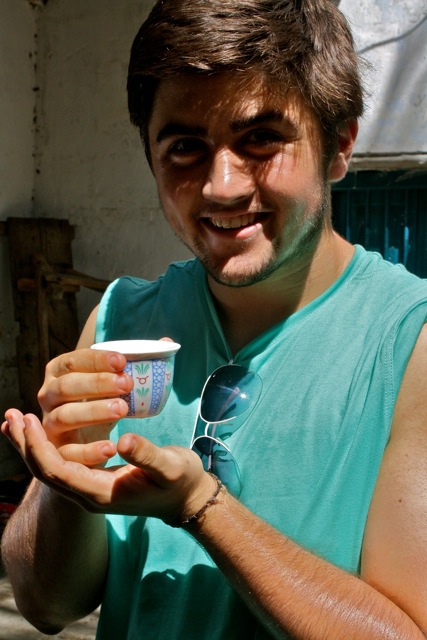
Walking through the maze of streets that is Stone Town we stumbled upon a square buzzing with local activity and stopped for a cup of local Zanzibari Coffee. Steaming hot, it had quite a distinct but delicious and strong taste and of course it was nice to share some more local culture.


Another vibrant aspect of Zanzibar that caught our eyes was the famous ornately carved doors. While the styles differ between Hinduism and Islamic doors their beauty does not. On the Left: The Islamic door Square and brightly colored made to keep out evil spirits from the homes. Center & Right: A hindu door arched/circular and equipped with several spikes. A tradition brought straight form India where these spikes are used to keep thieves on elephants from breaking into houses.


Our last stop on the tour was one of Stone Town’s main attractions, the House of Wonders. Built in the 19th century by the Sheik of Zanzibar it is now the National Museum as well as being the tallest building in all of Zanzibar. It houses cultural items and much of the history of Zanzibar even before liberation in 1961.


An amazing picture of a 19th century ivory warehouse in London. It was hard, and sad to imagine the sheer number of elephants that we’re killed to get the amount of ivory seen here.


Under the picture was an authentic Elephant tusk about two meters long and completely oxidized with age. 


Probably the scariest and oldest thing in the entire museum... was not a museum piece but rather the museums fire extinguisher which looked older than the building itself. 

27 April, 2011

First Impressions: Teaching at Magereza Prison Nursery School

Since Eliroi Nursery school went on vacation for two weeks for the Easter holidays, I was transferred to teach, for those two weeks, at the Magereza Prison Nursery school. The school is located inside the Magereza Prison, where the families of convicts can live peacefully without the negative stigma in the community. I was very excited to teach here as some of my co-volunteers already taught here for weeks and raved about the kids and their wonderful personalities.


Some of the adorable faces:


              Grace       -   Montoum
              Rose       -    Georgie
    Grace + Kate   -      Angel


Our day starts every morning around 8 with an hour of play time out on the playground. A blessing, after coming from Eliroi where the kids have enough energy to tire you out in minutes. Luckily Magereza has more resources than Eliroi and the children have a swing set and slide and many somewhat inflated soccer balls.


Teacher Mzungu posing on the playground with some help of course!


Left: Daniel (our local volunteer and lifesaver as he is a walking swahili translator) poses with Furgesi under a painfully colorful umbrella one rainy morning.

Right: Teacher Elkie, a volunteer from the Eli Lilian Pharma Company, posing with some of her kiddies. On the first day.


After an hour of messy play on the muddy ground the kids (and I) are called inside for lessons. Shoes are taken off on rainy days and “neatly” placed by the door ;)


A look inside Class A, the highest class, with approximately 25-30 kids. The classrooms are a bit more spacious than Eliroi’s as this is a legitimate school building as opposed to a converted storage shed. The kids are usually taught one lesson a day alternating between english (spelling/alphabet) and Mathematics (counting/addition). Morning lessons are followed by lunch and then by another play time period.


After the Second playtime the supposedly now ‘calm’ kids are called inside once again for some activity. This day I was elected as the entertainment, reading aloud to all three classes piled into one room: the tale of Curious George. Daniel was of course there to help with whatever was lost in translation. . .

21 April, 2011

A ‘Batik' Art Class

Batik (Bah-teek) is an ancient art method using wax, simple linen cloth, and several dyes. Pictures are made in a process which starts by selecting the locations of the lightest color i.e. white and then a progression is made to using darker and darker colors until the last color which is black.


A sample Batik made by a prior volunteer of many African species united under the baobab tree. It made it look a lot easier than it actually was.


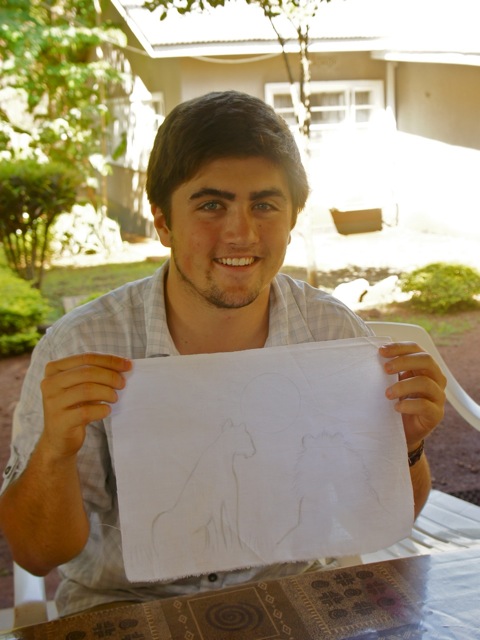
The beginning: First I carefully traced the picture I had selected which was two lions admiring the sunset.


While we were tracing our pictures, wax was melted in a bunsen burner-like contraption.


Next, very carefully, wax is added using a paint brush to the areas that need to stay white.


After the wax has dried color is added to the picture starting with the lightest colors such as yellow. The painting is made completely wet so that the die does not spread through the cloth. All of the dyes are made from plants in the area.


Of course some help from Sam (our teacher) was necessary to keep the batik from turning into a disaster. The process of adding wax and adding darker colors is repeated until the last color (black) is reached. Then all of the wax is rubbed off and the painting is ironed, making it somewhat stiff and accentuating the colors.


Once the final product is reached small touch ups are made to keep the silhouettes exact and Voila!